
 Agmo is now part of the Claude Partner Network. Build and deploy enterprise AI with Claude securely.Read More →
Cyber Security
Business Email Compromise Losses Nearly Tripled in Singapore: How to Harden Your Payment Workflow
|
6
min read
Singapore’s scam numbers are finally falling. The Singapore Police Force’s Mid-Year Scam and Cybercrime Brief 2026 shows scam cases down 14.4% and losses down 17.9% in the first half of the year, to about S$410.6 million.
One category went the other way, and it targets businesses rather than individuals. Losses to business email compromise (BEC) rose 193.1%, from S$19.5 million to S$57.3 million, and the number of cases rose 67.9%, from 156 to 262.
That works out to roughly S$219,000 lost per BEC case, against a median loss of S$1,350 across all scams. BEC is now one of the five most costly scam types in Singapore. This article explains how it works and the payment controls that stop it.
The numbers at a glance
Measure (January to June) | 2025 | 2026 | Change |
|---|---|---|---|
All scam cases | 19,644 | 16,821 | −14.4% |
Total lost to scams | S$500.2 million | S$410.6 million | −17.9% |
Business email compromise cases | 156 | 262 | +67.9% |
Lost to business email compromise | S$19.5 million | S$57.3 million | +193.1% |
Median loss per scam case | S$1,682 | S$1,350 | −19.8% |
Source: Singapore Police Force, Mid-Year Scam and Cybercrime Brief 2026.
How business email compromise works
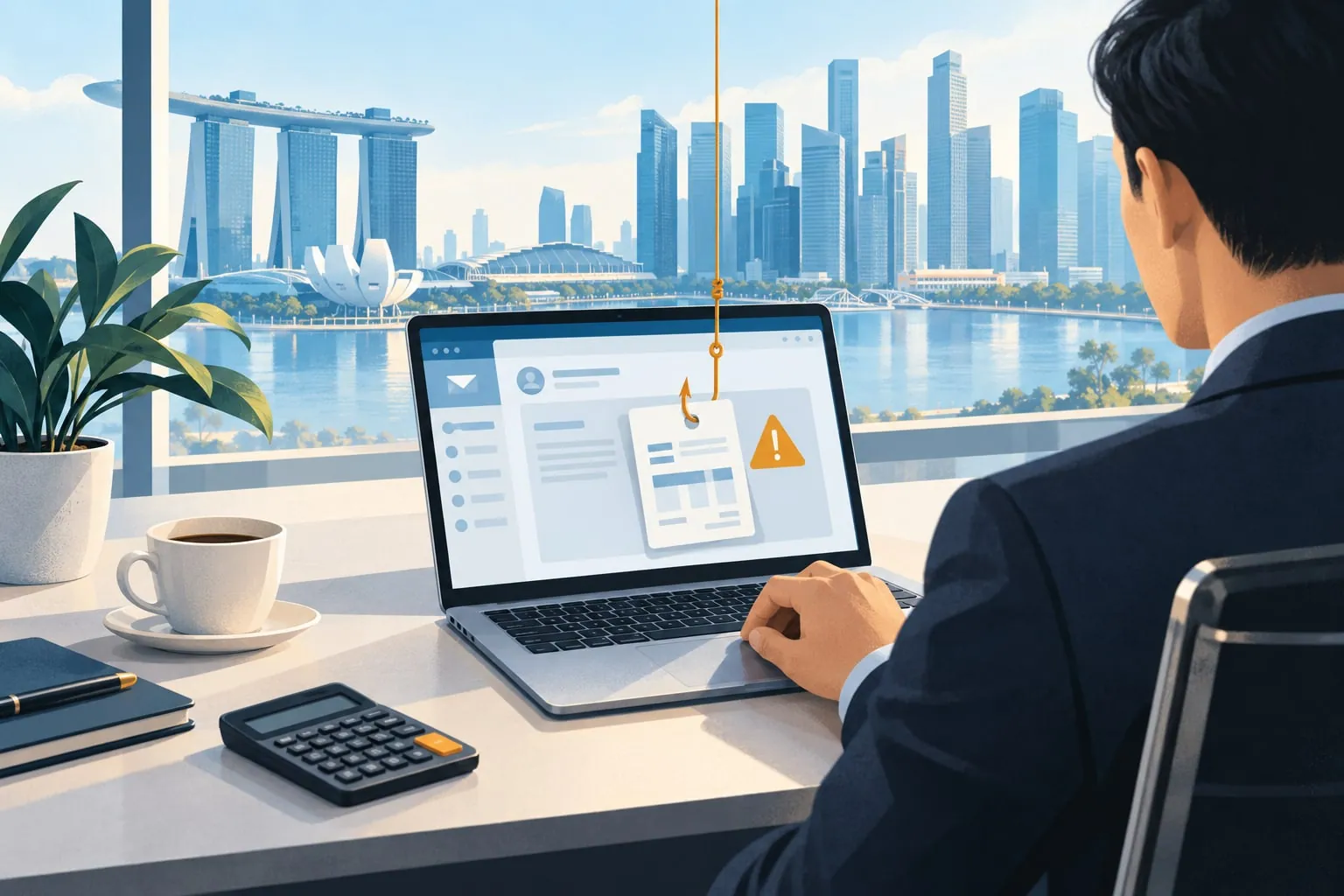
In a BEC scam, the criminal pretends to be someone your finance team already trusts: a supplier, a client, or a senior person inside your own company. They use a spoofed address, a lookalike domain, or a real mailbox they have broken into.
The police brief highlights one variant above the rest. A “supplier” emails to say their bank details have changed. Sometimes they attach an invoice with the real company’s address, letterhead, signature and stamp. The finance team pays the new account. The fraud only surfaces weeks later, when the real supplier chases a late payment.
Nothing in that story requires hacking your bank. Most scams in Singapore work the same way: in the first half of 2026, 80.8% of reported scams involved victims making the transfer themselves after being deceived.
Why email is the weak point
BEC works because many companies still run supplier payments on email. The request arrives by email, the approval happens by email, and a bank detail change is often typed into the accounting system straight from an email. Whoever controls the email thread controls the money.
Training helps, but a well-made fake invoice from a compromised supplier mailbox can fool careful people. The lasting fix is to change the process, so that no single email can move money to a new account.
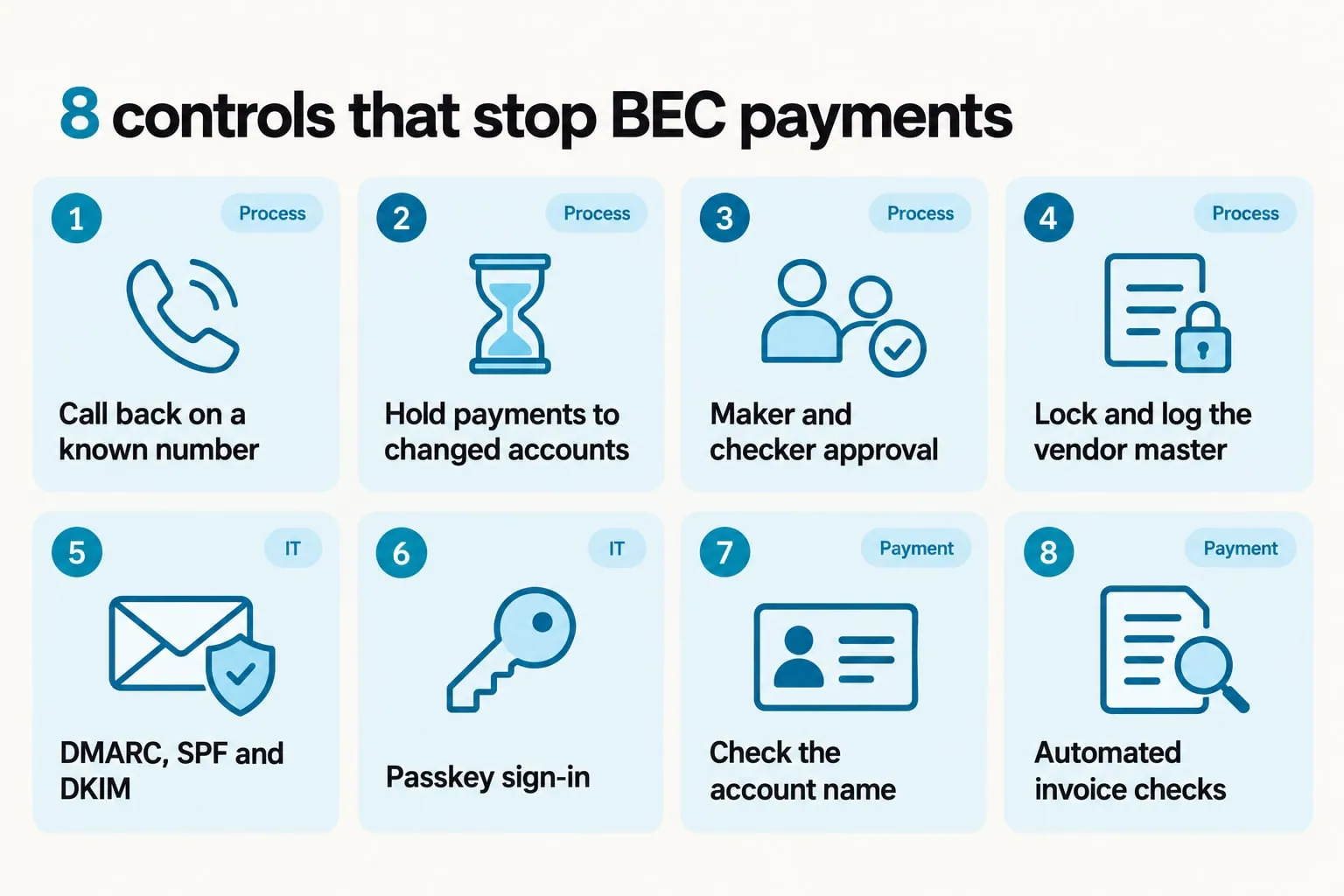
Eight controls that stop BEC payments
Control | What it stops | How to put it in place |
|---|---|---|
1. Call back on a known number | Fake bank detail changes | Verify every change by phoning the supplier on the number already on file, never one in the email |
2. Hold payments to changed accounts | Rushed first payments to a new account | Hold the first payment to a new or changed account for 24 to 48 hours, like the cooling-off period banks use under the Shared Responsibility Framework |
3. Maker and checker in the system | One person being fooled | Require a second approver above a set amount, inside the finance system rather than by email reply |
4. Lock and log the vendor master | Silent edits to bank details | Limit who can edit supplier bank details, log every change, and email the supplier’s known contact when one happens |
5. DMARC, SPF and DKIM | Spoofed emails using your domain | Publish SPF and DKIM, move DMARC to a reject policy, and flag lookalike domains and external senders |
6. Phishing-resistant sign-in | Stolen mailbox passwords | Use passkeys or hardware keys for email and finance systems; Singpass has offered passkeys since 1 July 2026 |
7. Check the account name | Paying a stranger’s account | Where your bank or PayNow shows the registered name, confirm it matches the supplier before paying |
8. Automated invoice checks | Anomalies people miss | Compare each invoice’s bank details, amount and sender domain with the vendor master, and stop mismatches before approval |
Controls 1 to 4 are process. Controls 5 and 6 are IT. Control 8 is where software takes over the checking that tired people skip on a busy month-end.
A safer bank detail change, step by step
The single most valuable fix is to make bank detail changes slow and verified. A good workflow looks like this:
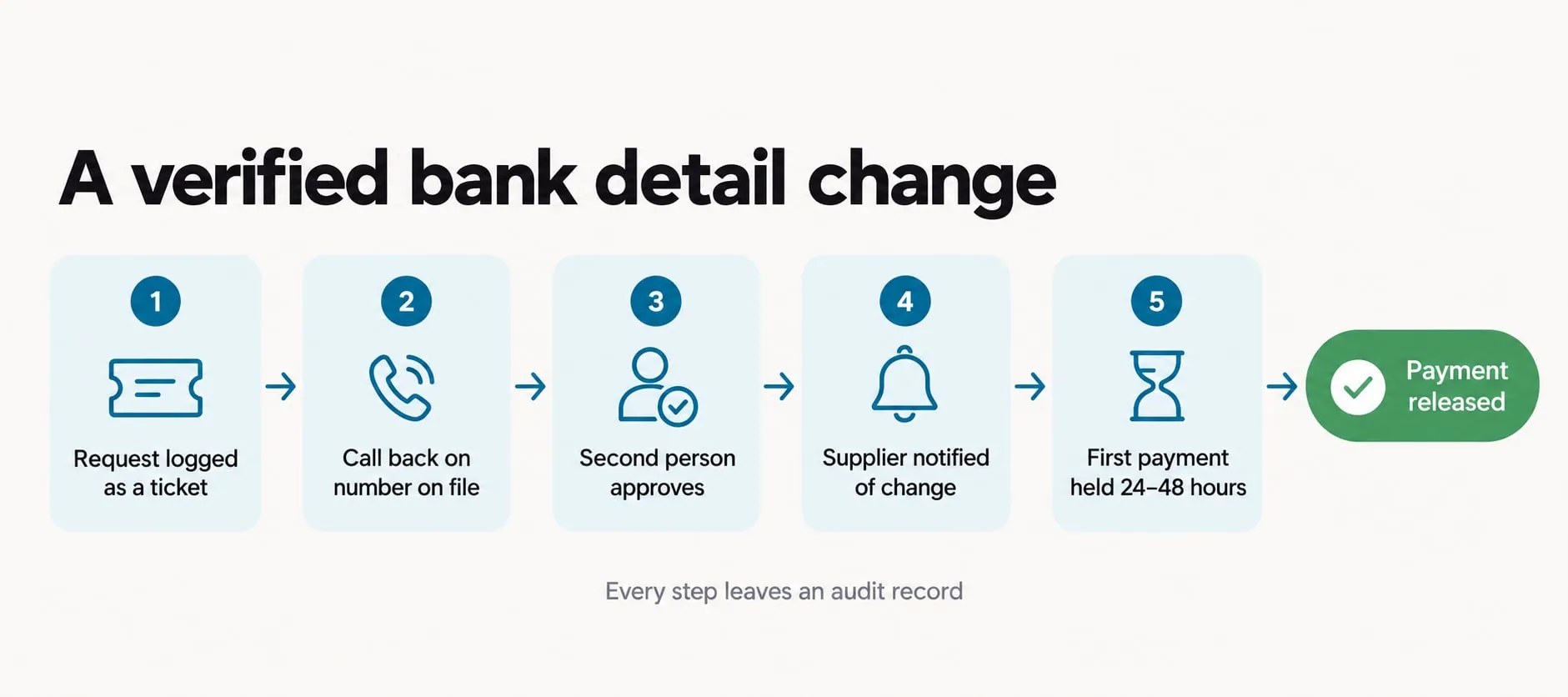
The change request is logged as a ticket in the finance system, not acted on from the email.
A finance officer calls the supplier on the number already on file and records the result.
A second person approves the change in the system.
The supplier’s known contact gets an automatic notice that their bank details were changed.
The first payment to the new account is held for 24 to 48 hours, then released.
Each step leaves a record, so an auditor can see who verified the change and when.
Where automation and AI help
An automated check can read every incoming invoice, pull out the bank account, amount and sender, and compare them with the vendor master and payment history. A mismatch, a first payment to a new account, or an email from a domain one letter off from the real one goes to a person before it reaches the approval queue.
This is a good fit for a workflow tool such as n8n connected to your accounting system, or an AI agent that reads invoices in any layout. It does not replace the call-back. It makes sure the call-back happens on the payments that need it.
The same principles apply to anyone building payment features. If you run an e-wallet, a marketplace or a customer app that moves money, build cooling-off periods, payee name display, alerts for new payees and passkey sign-in into the product from the start. Payment service providers that issue e-wallets already carry duties under the Shared Responsibility Framework for phishing scams.
If you think you have paid a scammer
Call your bank at once and ask it to stop or recall the transfer. The first hours matter most.
Make a police report. The Anti-Scam Centre recovered more than S$97.7 million of scam losses in the first half of 2026 by freezing scammer and mule accounts.
Call the ScamShield Helpline on 1799 if you are unsure whether a request is real.
Reset the passwords and sessions of any mailbox that may be compromised, and tell the supplier you were impersonated so they can warn their other customers.
Frequently asked questions
What is business email compromise?
It is a scam in which criminals impersonate a supplier, client or senior colleague by email to trick a business into paying a fraudulent account or sending money on request.
How much did Singapore businesses lose to BEC in 2026?
According to the Singapore Police Force, BEC losses reached S$57.3 million in the first half of 2026, up 193.1% from S$19.5 million in the same period of 2025, across 262 reported cases.
What is the most effective control against BEC?
Verifying every supplier bank detail change by calling a phone number already on file, then holding the first payment to the new account for a short period. Most BEC losses come from changed bank details.
Does the Shared Responsibility Framework cover BEC?
No. The framework covers phishing scams and sets duties for banks, e-wallet issuers and telcos. BEC losses usually come from payments a business made itself, so its own controls are the main defence.
Talk to us
Agmo builds finance workflows, payment apps and e-wallets for organisations in Singapore, delivered under the Agmo group’s ISO/IEC 27001:2022-certified information security management system. If you want bank detail changes, approvals and invoice checks moved out of email and into a system that leaves a record, we can help you plan it.