

 Agmo is now part of the Claude Partner Network. Build and deploy enterprise AI with Claude securely.Read More →
Technology
MOM’s Hourly PM2.5 Guidance: How to Automate Outdoor Work Decisions During the Haze
|
6
min read

On 20 October 2026 the Ministry of Manpower (MOM) gave employers a new instrument for the haze: the 1-hour PM2.5 reading. The 24-hour PSI forecast is still how you plan tomorrow’s outdoor work. The hourly PM2.5 reading is now how you adjust it today, as the air changes.
That small change turns a daily decision into an hourly one. At 9am on 21 October, NEA’s feed put central Singapore at 81 µg/m³ and the west at 70, both in the Elevated band, while the north and south sat in the Normal band. A company with crews in Jurong, Toa Payoh and Changi would have had different instructions for each site, and they could all change by lunchtime.
This guide explains the four bands, why checking them by hand breaks down across several sites, and how to automate the alert, the roster check and the record in a few days.
What MOM changed on 20 October 2026
MOM’s guidance supplements its existing PSI-based haze guidelines. Employers should use the PSI forecast to plan the next day’s outdoor work, then use 1-hour PM2.5 readings to adjust work during the day.
The guidance separates two groups of employees:
Healthy employees.
Vulnerable employees: the elderly, pregnant women, and employees with chronic heart or lung disease.
It also asks employers with outdoor workers to keep at least a one-week supply of masks as part of their haze business continuity plan.
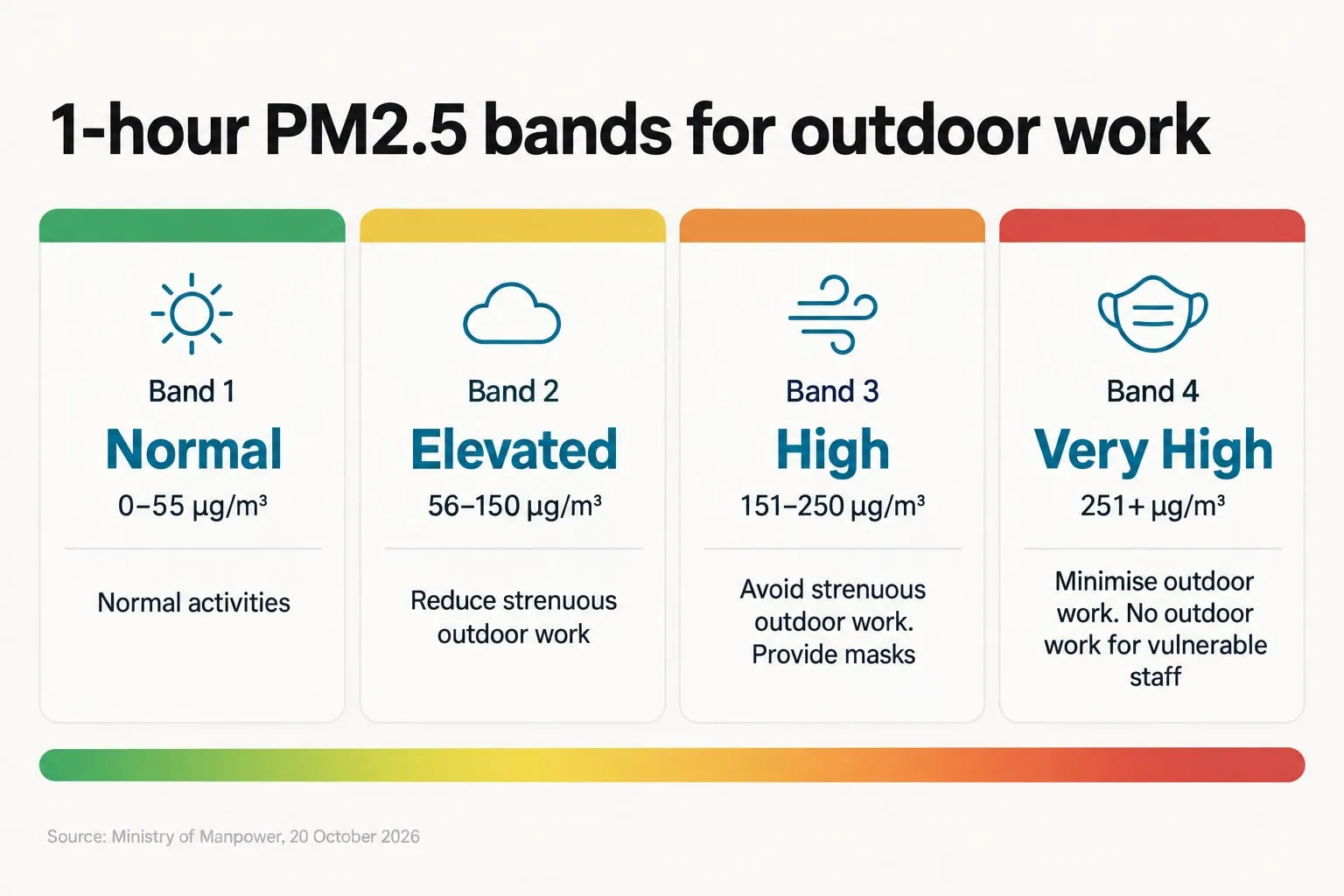
The four 1-hour PM2.5 bands
Each band sets what healthy and vulnerable employees should do, and what the employer should put in place.
Band (1-hour PM2.5, µg/m³) | Healthy employees | Vulnerable employees | Employer measures |
|---|---|---|---|
1. Normal (0 to 55) | Normal activities | Normal activities | Monitor the haze situation |
2. Elevated (56 to 150) | Reduce strenuous outdoor work | Avoid strenuous outdoor work | Use mechanical aids, job rotation, indoor rest breaks and hydration to lower the risk |
3. High (151 to 250) | Avoid strenuous outdoor work | Avoid outdoor work | Provide masks if strenuous outdoor work cannot be avoided |
4. Very High (251 and above) | Minimise outdoor work | Outdoor work prohibited | Defer non-essential work or cut its intensity and duration; provide masks or respirators if work cannot be avoided; hourly rest breaks of about 10 to 15 minutes, indoors where possible; allow for poor visibility in crane lifting |
The bands are guidance, but they sit on top of every employer’s existing duty to keep workers safe, so expect them to be the yardstick if something goes wrong.
Why checking by hand breaks down
For one site and one supervisor, refreshing haze.gov.sg every hour works. It stops working as soon as the operation has any scale:
Readings are regional and hourly. NEA publishes five regions (north, south, east, west and central), and a reading can cross a band boundary at any hour.
The people who need to act are in the field. Supervisors are on scaffolds, in vans or on a vessel, not watching a dashboard.
The vulnerable list lives somewhere else. Who is pregnant, over a certain age or has a declared condition sits with HR, not with the site lead.
Nobody writes down what was done. When a client, insurer or MOM inspector asks what happened at 2pm on a Band 3 day, “we told them on WhatsApp” is not a record.
Each of those is a data problem, and data problems automate well.
A five-step automation blueprint
This is the workflow we would build for a contractor, facilities manager or logistics operator with outdoor crews across Singapore.
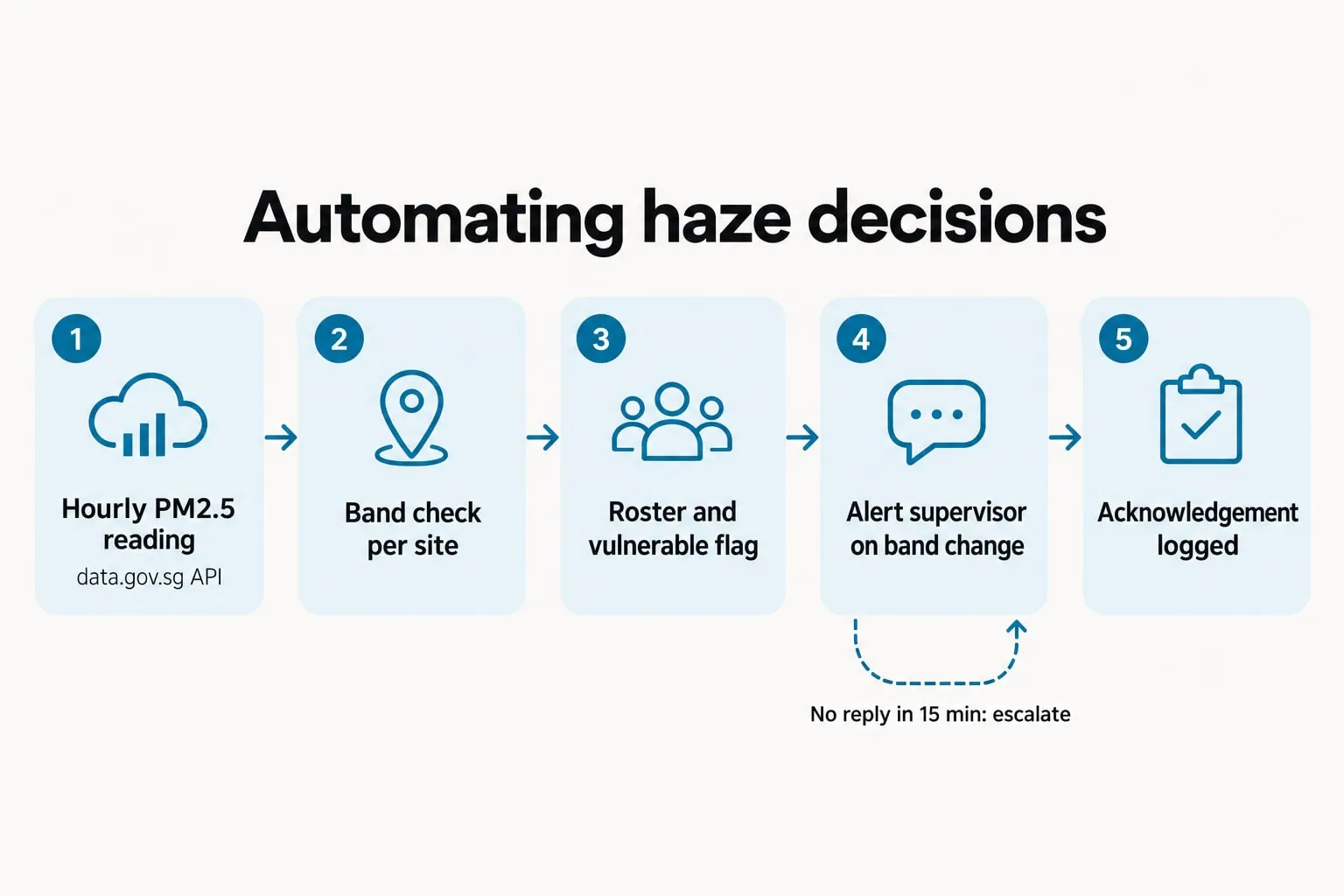
1. Pull the reading every hour
NEA’s 1-hour PM2.5 readings are published free on data.gov.sg through a real-time API, with one value for each of the five regions and a timestamp. A scheduled job calls it a few minutes past each hour. An API key from data.gov.sg raises the rate limit, which matters if other systems share the same key.
2. Map each worksite to a region and a band
Give every active site a region once, in a simple table. Each hour, the workflow looks up the site’s regional reading and works out its band. Keep the band thresholds in one configuration table, so a future MOM revision is a one-line change.
3. Check who is rostered there
Read today’s roster from the rostering or HR system and flag anyone marked as vulnerable. Store only a yes or no flag for the haze workflow, not the medical reason. That keeps the workflow useful without spreading health data that the PDPA expects you to protect.
4. Alert the supervisor only when something changes
Send a message when a site’s band goes up or down, not every hour. Supervisors ignore alerts that repeat. A good message says what changed, what to do, and who it affects:
“Band 3 (High) at Jurong West site, PM2.5 162 at 2pm. Healthy crew: stop strenuous outdoor work; issue masks if it cannot stop. Vulnerable crew (2 rostered): move indoors now. Reply OK to confirm.”
WhatsApp, Microsoft Teams, Telegram or SMS all work. Use the channel the crew already uses.
5. Log the acknowledgement and check the masks
Record each alert, who received it, and when they confirmed. If nobody confirms within 15 minutes, escalate to the next person. Once a day, compare the mask count reported by each site with the one-week supply MOM asks for, and flag any shortfall before the haze gets worse.
n8n workflow or a custom app?
Most companies should start with a workflow tool. An n8n workflow can do all five steps above: the hourly schedule, the API call, the lookup tables, the messaging and the log. It connects to HR systems, spreadsheets and chat tools without a full software project, and a first version takes days rather than months.
A custom app makes sense when the field side needs more than a message: offline check-ins on sites with poor signal, photo evidence of masks issued, a supervisor view of every crew, or integration into an existing workforce or safety platform. It is also the better choice when the same app has to carry heat stress, lightning and other site safety checks.
Guardrails before you switch it on
Treat the reading as regional, not site-specific. A regional value is a strong signal, not a sensor on your site. Supervisors should still act on what they see, such as visibility or workers reporting symptoms.
Alert when the data goes stale. If the API fails or the timestamp stops moving, tell someone to check haze.gov.sg by hand. Silence must never mean “all clear”.
Keep a person in the decision. Let the workflow recommend and record. Let a supervisor decide to stop or move work.
Protect the vulnerable flag. Limit who can see it, and get consent for how it is used.
The same pattern works for heat stress
MOM’s heat stress framework for outdoor workers runs on a similar idea: Wet Bulb Globe Temperature (WBGT) bands, hourly monitoring, and required measures such as hydration and shaded rest breaks at each band. A company that automates haze alerts already has most of the pieces for heat stress: the site table, the roster check, the messaging and the log. The second workflow costs a fraction of the first.
Frequently asked questions
Does the 1-hour PM2.5 reading replace the PSI?
No. MOM asks employers to keep using the 24-hour PSI forecast to plan the next day’s outdoor work, and to use 1-hour PM2.5 readings to adjust work during the day.
Who counts as a vulnerable employee?
MOM’s guidance names the elderly, pregnant women, and employees with chronic heart or lung disease. In the Very High band, outdoor work is prohibited for them.
Where do the hourly readings come from?
NEA publishes them on haze.gov.sg and through the free real-time PM2.5 API on data.gov.sg, with a reading for each of Singapore’s five regions every hour.
How long does it take to automate haze alerts?
A first n8n workflow that pulls the readings, checks each site and alerts supervisors can usually be built and tested within a week, provided the site list and roster data are available.
Talk to us
Agmo designs, secures and runs n8n workflows and custom field apps for organisations in Singapore. If your crews work outdoors and you want haze and heat alerts that reach the right person and leave a record, we can help you scope it in a single call.